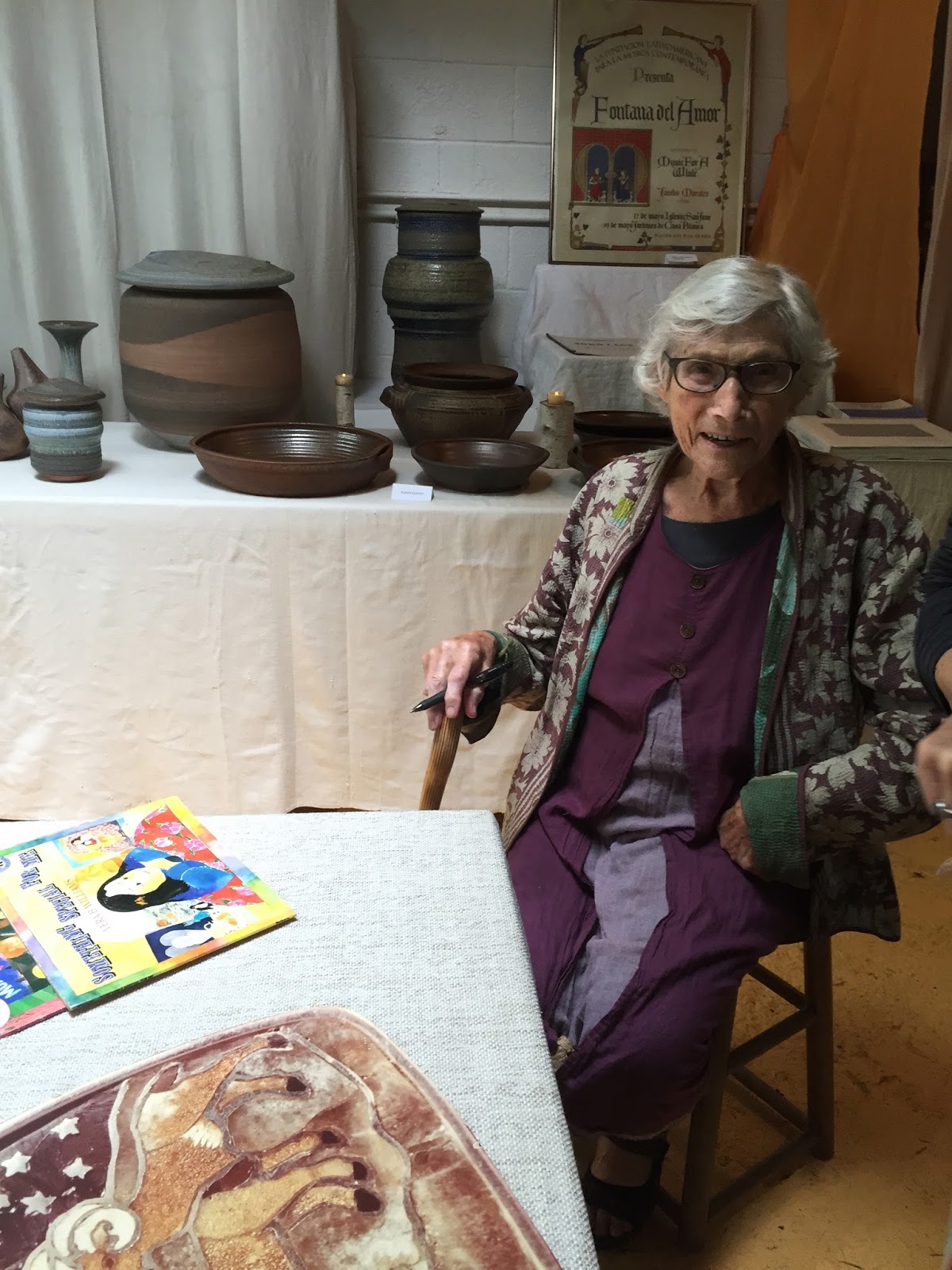
Thursday, September 24, 2015
Words of Walt Whitman
The words by Pope Francis today reminded me of this alluring quote.
"This is what you shall do: love the earth, and sun, and animals, despise riches, stand up for the stupid and crazy, hate tyrants, argue not concerning God, have patience and indulgence towards the people, take off your hat to nothing known or unknown or to any man or number of men, go freely with powerful uneducated persons, re-examine all you have been told at school or church or in any book, and dismiss whatever insults your own soul." Walt Whitman
Labels:
#popefrancis,
#PopeinDC,
#PopeinNYC,
#PopeinUS,
Pope Francis,
Walt Whitman
Sunday, September 6, 2015
Bicycle Built For Mayhem
Back by popular demand - Guest Blogger Eric Crowe. Another Florida story.
The day the bear came home with us for dinner Mom was on the couch with her leg in a cast. She had broken it trying to teach me how to dismount my new bike. It was not simply a broken leg; it was a compound fracture of the ankle with three breaks in the leg.
See, our neighborhood was spread out and sparsely populated. If I was going to visit even the nearest kid, it was all the way down to the end of Luzon Avenue and then up that sandy track to the O'Neils' house. If I wanted to visit somebody else, it was even farther (and more complicated). You couldn't just walk. It took too long to get anywhere, and if you went on foot to the O’Neil place without an O’Neil, you stood a pretty good chance of being shot, or eaten by their dogs. Uninvited visitors were not encouraged.
As I explained before, Luzon Avenue was where the last, outermost hint of suburbia abutted old country Florida. The only other kids on Luzon Avenue were the O'Neils. There was Mikey, who was my age, and his little sister Patty, and a shifting array of their cousins. But even the O Neils didn't really live on my street. They lived at the end of it, or really beyond the end of it. Their property started beyond the end of the road, but their house and barn and various other outbuildings were quite a ways up a sandy track. It started after the shell-rock ended. You couldn't even see their house from the end of the Luzon Avenue. And it was in a different world. Although no one talked about it, the difference between those who lived on pavement, who lived on shell rock, and who lived on a dirt road signaled a definite cultural divide. But that divide didn't matter much to me, and even less to Mikey. What mattered was distance.
So believe me when I say that I needed a bike. What I wanted, and got, was not just a kid bike like I'd had before, or one like stupid Butchy Holmes still had, but a real bike, one with speeds.
I had pushed and pushed for a real bike, and was very glad to have gotten one. It was a thing of beauty, a bronze Raleigh three-speed that you shifted with your thumb, and pedals that allowed you to coast. It was worlds above and beyond the nasty Huffy that Butchy Holmes rode, with pedals that kept going round no matter what. But it was, ahem, kinda big.
See, my father was a frugal man, at least when it came to bicycles. So he had purchased a 36" frame bike on the theory that if you were going to spend money on it, get just one bike. One that the kid could ride right up until he was in high school. In order to get on my bike, I had to lean it against a tree or a pole, and then climb onto it and push off. I had to push off because I could only reach the pedals when they were in the top half of a cycle. But then there was getting off.
The main dismount technique I had devised was to go as slowly as possible and then bail out. The semi-controlled crash was at best, frowned upon. While I tried to bail out where the bike and I would have a soft landing, this wasn't always possible. The results varied for both me and the bike, but they never looked good.
The subject of my dismount technique soon came up with my parents. Neither approved. My father thought it unlikely that the bicycle would last through high school if I kept crashing it, on even the softest of lawns. My mom just thought my dismount was ungainly and in poor form.
One Sunday after church and brunch (the wildest stuff seemed to happen on Sundays) Mom decided that she was going to show me how to properly dismount the bike. As an aside, I need to add that Mom worked selling advertising for the Palm Beach Post, and spent most of her time with people in old-money and tourist commerce Florida. Those were her people. We were Catholic, but not very strident about it. Going to church involved going to a diocese near the beach, far from our home and was almost always followed by brunch where they served Bloody Mary's.
We had just gotten home from church and brunch. Mom still had on her hat with the little bit of veil that extended over the eyes and a suit with a below knee length, sheath type skirt and heels. None of this mattered. It was time to show me a graceful dismount. She was tall enough to get on the bike with no real problem despite that sheath skirt. She began to pedal around on Luzon Avenue back and forth in front of the house where my father and I were standing in the yard. As she went by she would give little tips about bicycle etiquette and technique.
The sight of her pedaling around Luzon Avenue in her Sunday best was so arresting that it stopped Grady ONeil, who was heading home, dead in his tracks. As he sat there in his truck, just beyond the range of my mother's circuits, she swung into the yard to demonstrate the dismount. She was talking to us about how to balance on the top of the pedal and swing a leg over, and it appeared that she was demonstrating this very technique in super-slo-mo. Meanwhile, the bike was going slower and slower and slower. I was thinking to myself, "Okay Mom, I've got it.” Then the bike went over with her still in the frozen yet graceful one-leg-in-the-air pose. The skirt had caught on the frame.
After she crashed, we all rushed to her. It was not good. The bones were sticking out of her ankle and the leg was at an impossible angle. My father rushed into the house to call an ambulance.
Grady jumped out and left his truck in the road and was right there with Mom. Before that day he had been just a kind of mean old cracker who lived up the road. From then on he and the rest of the O’Neils were friends.
Grady was a rock in the crisis, calm and collected yet solicitous. He told me and Mom that it would be all right, we just had to hang in there until the ambulance arrived. While they were talking, Grady mentioned to Mom that while Lynne, his wife had recently made him take the pledge, i.e., foreswear any alcohol intake, there might still be some around. It was kept on hand strictly for emergencies, he said, but this definitely qualified. Mom agreed. With that Grady hurried to his truck and zipped up the road. He soon returned with a jar of clear liquid. He administered the treatment and by the time the ambulance arrived, Mom was, as they say, feeling no pain.
Labels:
Florida,
Moonshine,
Raleigh Bike
Thursday, August 20, 2015
The Day My Father Brought The Bear Home To Dinner
Tales From The Old South
By Guest Blogger Eric Crowe
This story first needs some background and explanation about its setting: south Florida, Palm
Beach County in the 1950’s. In those days there were three very distinct versions of that place. They coexisted
geographically on an east to west axis, with only a few areas of uneasy overlap. There was First
Florida, or Florida One. It was the grand, old-money winter resort inhabited periodically by the likes of
the Kennedys, Vanderbilts, Whitneys, Reynolds and spawn of other robber barons and society elite. It
had chic shops, art galleries, live theatre and lots of royal palms that waved in the ocean breeze. You
could get an extra dry martini, Lacoste polo shirt or a yachting cap there at, well, the drop of a hat. It had
lots of private beach clubs, many golf courses and even some polo grounds. Its boundaries ran along the
coast from Vero Beach south to Boca Raton. (There were lots of places south of Boca that were as
moneyed as First Florida, but still did not inhabit its own special cultural niche.) First Florida started at
the edge of the Atlantic ocean and stopped pretty much at the edge of the Inter-Coastal waterway.
Then there was Second Florida. It was peopled mainly by less-moneyed snowbirds of a lower social and cultural class that those in First. They were people who came from places like Canada, New York and Ohio to stay for a couple of weeks or a month. Along with them were lots of pipe-suckinggiant-hat-glasses-and-orthopedic-shoe-wearing retirees. In Second, many of the restaurants featured early-bird seating and sunset specials. Second was also where most of us permanent residents who earned their living providing goods, services and entertainment to First Florida and Second Florida lived. You could readily get some sansabelt slacks, a shuffleboard cue or some fuller’s earth for your pool filter in Second. Except for a few odd pockets like Briny Breezes and Lantana that intruded into first territory, Second lay to the west of the Inter-Coastal, where it extended a few miles, or sometimes only a few hundred yards further west-ward. Second ended at about the point where no trace of the ocean breezes penetrated inland unless there was a hurricane.
Then there was Florida Three, the old-original Florida. It ran west from about the point the trade winds no longer penetrated eastward into the wilds of lake Okeechobee and the Everglades. Florida Three had few resorts, not many snowbirds or retirees and little to no patience or regard for Florida One or Two. Instead, what it had were ranchers, farmers, swampers and other people who lived mainly off the land in one way or another. You could get catfish and hushpuppies, shells for a 4-10 or Can’t Bust-em overalls with the front-flap in Three quick as you could spit some chaw. Its inhabitants were mainly black, brown or red of skin and/or neck. They didn’t need or use Coppertone and were proud of it.
Three was filled with things that bit, scratched, punctured and poisoned. Things that made you jump when they went bump in the night. It had stuff like gators and garfish, rattlesnakes and water moccasins, snapping turtles and big land tortoises. It had lots of insects that bit, like mosquitos, chiggers, and fire ants. It had giant, leathery bugs that looked like they would bite or sting, even if they didn’t. It also had lots of plants that cut, poisoned and stuck you. Plants like sandspurs, saw-grass, palmettos, Spanish bayonets and many other thorny or itchy things. Most of the dogs that lived in Three had ticks, and it was not considered remarkable if they had lost an eye or a leg. A great deal of Three consisted of miles of palmettos interspersed with scrub pines and grassland, but there were also lots of canals and swamps covered in algae and hyacinth. It was pretty uniformly hot, humid and flat in Three.
My earliest memories are of living where Florida Two ran into Florida Three. We lived on Luzon Avenue. It was way west of Lake Worth and even west of Military Trail, a geographic and cultural dividing line. If you wanted to be charitable you could say Luzon Avenue was a westernmost outpost of Two, but most of it was really in and part of Three. We lived there because this was where my father built our house.
My dad worked in Florida Two as a dispatcher and foreman for the Rinker truck drivers. (More on that later.) Our house was pretty large for just the three of us because, as the dispatcher for a concrete block and transit mix company, he got a very good deal on these main construction materials (i.e., free). But since we also had to have some land to put that house on, that land was in Three. This was because land was cheap in Three. Moreover, you could build pretty much whatever kind of house you wanted to, and build it however you wanted to do it. No pesky building inspectors involved. This suited my father’s philosophy, as well as his house-building skills. It also explained the rather unique means by which the hot water heater connected to the bathrooms and the kitchen.
So our house was on Luzon Avenue-nominally a far-flung outpost of Two, but really in Three. The first clue about this was that Luzon Avenue wasn't paved. It was a "shell rock" road of crushed white coquina and coral. Everyone could spot this as an old-Florida road material. If that wasn’t enough tip-off, conditions at the end of Luzon Avenue left no doubt. While the first house on the street was a tidy bungalow with green awnings, in which Emily and Vincent Pangalon lived (i.e., some of the people who put the Luzon onto Luzon Ave.), the shell rock ended at the gate to the O' Neil's place. It was just sand and dirt from that point onward.
The O'Neil's were large and a lively bunch. Their family had been living in the area way before anyone else moved in. They turned out to be good neighbors and friends, especially in a pinch. But this was hard to predict from first impressions. None of the senior O' Neil’s, Grady or Lynne, or Grady’s brother Jelly, had any teeth of their own. Moreover, Grady actually still made moonshine and made it on the premises in a still. But I digress.
The only reason any of this relates to the story of the bear who came to dinner is simply that you must be introduced to the fact that our house and roads we travelled to get to it were in Three. These roads were frequented by all sorts of travelers who were not often to be found in One or Two. This is why, as my father and I were heading back home one Sunday afternoon, from some sort of errand or other, he didn't seem to be all that surprised when we came upon the man standing on the shoulder of the road next to the canal, with his thumb out, hitchhiking with the bear.
When he saw them, dad immediately began to slow down. We pulled to a stop just past where they were standing. Dad backed the Impala up and asked the guy if he needed a ride. He said they did. So dad and the guy talked for a while about whether the bear was a good passenger. The guy allowed as how he was. He said the bear was well mannered, used to car travel, and what's more, unusually presentable at the moment, since it had just had a bath in the canal. After a little more discussion it was decided that there was plenty of room for all of us in the car, as it was a convertible and we already had the top down, as long as all the humans rode in front.
So I scooted into the middle, the guy got in next to me and the bear got in the back seat. I could tell that the guy must be telling the truth about the bear’s bath as soon as it got in the car, because it was still pretty damp and smelled like canal water. My father and the guy quickly became occupied talking about where he was coming from (a town somewhere south of us where a circus had just ended its season) and headed to (Winter Haven, a circus winter-quarters town to the north). But I was too preoccupied by the bear in the backseat to pay much attention to this conversation.
I was kneeling on the front seat facing back toward the bear because somebody had to keep an eye on things. The Impala had a red leather bench backseat. When the bear sat on it, the whole seat squished down to no more than about three inches high. This seemed surprising, not just because of what it revealed about the weight of the creature sitting on it. It was also surprising because my father usually worried about preserving the condition of the leather so much that whenever I rode in the back seat I had to take off my shoes.
At first the bear just sat there, enjoying the breeze of our passage that had chased away the gnats and bugs that were surrounding it. The bear had a muzzle on. The muzzle was attached to a chain and the guy was holding onto the chain. That seemed somewhat reassuring. At least for a while, until, as I watched it and the bear looked right back at me with its big, dark-brown eyes, it just reached up and unsnapped the muzzle. Surprise!
It seemed like it took forever for my exclamations to penetrate the conversation going on in the front seat. When I eventually broke through with pointed comments about "hey, it took off the muzzle" the guy finally turned around and looked. He kind of jerked the chain around and said something like "cut that out." Then (I swear this is true) the bear just put the muzzle back on. No further fuss or discussion ensued. Nothing about the fact that the bear could take its muzzle off-or put it back on.
At some point, while I was focused on seeing if it would remove the muzzle again, or maybe do something others thought was remarkable, my father invited the hitchhikers to our house for dinner. Although I might not have known that bears were such good hitchhikers or could take off and put on muzzles until just then, I knew that this spelled trouble.
| Arla and Eric Crowe |
It was not just the surprise of suddenly appearing home with unannounced and unexpected dinner guests. My mom was pretty used to things like that happening. She was almost always happy to have company, but the problem was way more complex than that. It involved first, that mom was now sitting at home with a broken leg in a giant cast. (More on that later.) Second, it involved the fact that it would be Auntie Anne to whom we were bringing these guests home for Sunday dinner.
Auntie Anne had raised my mother. Although she was not vocal about her disapproval of my father, it was still palpable. While my mother often enjoyed it when my father hatched some crazy plan, Auntie Anne did not. Auntie Anne not only did not much approve of my father, she was also not that happy to be stuck in Three. In winter she was usually in One, where she spent her time in a cabana on the beach enjoying those trade winds and going out to dinner someplace that had a view. Instead, she was now sweltering at our house, where the fan just made you hotter, while she tended to Mom whose leg cast, from toes to hip, severely limited her usually prodigious ability to dispense hospitality.
So I smelled trouble brewing. When we pulled up in front, my father jumped out and began to yell: "Arla, Ar! You gotta see what I brought you." "What is it?" "A bear." "A what?" "It's a bear that was hitchhiking with its owner and we picked them up." "Well bring them in, you know I'm stuck here on the couch." (Mom later related that at that point she thought, given that my father was somewhat prone to exaggeration, that he must have been referring to a big dog, or to one of his hairier buddies, but not a real, actual bear.) So dad dutifully began to escort the guy and the bear toward the front door.
Then the screen door opened with a bang. Auntie Anne stood in the doorway. Her arms were crossed and she was quietly composed, but the look of frosty resolution in her eyes made everything just stop. It was only many, many years later, when I saw the scene where Gandalf confronts the Balrog on the bridge, that I ever encountered anything quite like that moment again. "Bob Crowe, you are NOT bringing that bear into this house." She stood there, all five foot one and ninety pounds of her and she didn't even yell, except for the NOT. But we all knew that bear was not coming into the house. Even the bear knew. Bear, you shall not pass!
After a while things calmed down. My mother was able to peek out the front window and see for herself that it was indeed a bear, whereupon she concurred that it was not invited into the house. The guy was invited to dinner. The bear stayed in the yard. I think we had chicken and the bear had some Gravy Train. Many stories were told, but the only other clear memory I have left of the evening from that point on, was about after dinner, when we went out to hang with the bear.
It had been sitting out there for quite a while by then and had attracted a pretty good sized gathering, at least for our sparse neighborhood. Among the onlookers was my arch-rival, Butchie Holmes. So it felt pretty good when the guy had the bear do a few tricks for us, and really good when the guy asked if I wanted to ride the bear. He put me on the bear's shoulders and it kind of loped around the yard for a minute. Beat that, Butchie. A couple of other kids got rides, but not Butchie.
Then the guy and the bear got back in the Impala and my father drove them somewhere to catch the next ride toward Winter Haven.
Labels:
Circus Bear,
Florida Black Bear,
Florida story,
Old South
Friday, August 14, 2015
Wedding Bells
They
say there is a “wedding season”. There certainly was in our family this year.
With eight grandchildren born in twelve years, there are bound to be some milestone
events that are close in time. We had a festive spring with two beautiful,
happy brides and two handsome, strong grooms.
My
adorable niece, Lily, married wonderful, dimpled Jimmy in April. It was only a
question of “when” with these two who have been so in love since high school.
When I congratulated the groom’s father he thanked me and announced gruffly,
“We’ve been waiting eleven years for this.” I think that was his way of saying
he was happy. I’d be happy, too, if my son was marrying Lily. Smart, lively and
funny, Lily has had a sparkle in her eye from the beginning. And she has rock
solid values, family values, thanks to my sister, Laura, and my brother-in-law,
Les.
Lily
and Jimmy had a co-ed shower and they had to answer questions about how well
they knew one another. They did not miss predicting a single answer. The one I
loved most was the question about what Lily would want Jimmy (who happens to be
a firefighter) to go back into the house to save after all the essentials had
been rescued. He said Lily’s Uggs. When Lily was brought in and asked what
Jimmy said he would save, she was confident in her answer. “My Uggs”, Lily
replied.
The
wedding in a campground was so perfectly them. It was rustic and inclusive and
traditional without being fussy. My nephew, Jeff, was a groomsmen, and sang a
beautiful song. I cried when Les made his father of the bride speech. You could
just feel how thankful and proud he was.
| Lily & Les |
| Lily |
The
cousins on our side are a motley crew, and I mean that in a good way. Lucy is
the oldest and Jeff, at 21, is the youngest. In business, in the military, in
PR, they run the gamut. Multi-national, they cover the spectrum: Scandinavian,
Italian, Chinese, English, Irish, Russian and Polish and more. They’re a
diverse group of young adults. Related, yet so different.
| Jimmy (left) joins the wild and crazy cousins. |
Lucy
didn’t really want a wedding shower, but three of her friends and I insisted.
She agreed only if it would be low-key and we’d just invite the local ladies so
it wouldn’t put pressure on the out of towners. Agreed. It was amazing how much
that celebration, that day, made it all real for Lucy and for me. I think
that’s the purpose of the tradition.
| Sisters from different misters. |
![]() |
| Lucy & Sarah - friends from birth. |
Ready for dinner.
| My lovely daughter. |
![]() |
| Lucy surrounded by my family. |
This
occasion, this wedding, truly was a celebration of Lucy and Greg and their
families and friends who love them. It feels really quiet in the family now
with no big events on the horizon. Almost too quiet. But things will change.
They always do. As they say, first comes love, then comes marriage, then comes
a baby in a baby carriage…
Thursday, July 30, 2015
A Day Late And A Dollar Short (And Other Platitudes)
| Our Tam High girls did a tennis fashion show in 2011. |
This week feels like a profound example of almost, not quite, woulda, coulda. So close, yet no cigar. It's the Boyle thing. Still, also. So many years and we were so close you could smell it. I also wrote about Boyle in 2013 - http://pearlsandlemons.blogspot.com/2013/09/cracks.html.
For more years than you can count on one hand - six to be exact, we have been raising money for the public tennis courts in our town. Three fund-raisers, several silent auctions and years of delays frustrated people and burned them out. It was much more involved and expensive than anticipated and it took a while to get the City involved. There was also the recession. We started out as a group of a dozen or more, but the "we" has devolved into the royal we, meaning mostly me.
| These girls grew up playing at Boyle. They are now in college! |
Our last hurdle was cleared recently in a mad scramble to collect on over $70,000 worth of pledges in three weeks. For that I had a lot of help, from Bill and Jeff and John. Still, I spent hours emailing and calling folks from NYC. I had already ordered printed thank you notes to send to over 300 folks who have volunteered and donated over the years.
![]() |
| Yours truly playing on Boyle in better days. |
![]() |
| Eric plays in the famous Boyle Woody. |
![]() |
| Boyle Woody photos by Dave Lee. |
And then the fickle finger of fate, that nasty other shoe dropped with a thud. The USTA Grant, the Facilities Improvement Grant that we've been working on since 2009, was awarded. That's the good news. The bad news is that it was awarded for $20,000 rather than the $50,000 we were expecting. Hmm, 50 minus 20 equals 30. Oh, no, Mr. Bill! Say it isn't so.
| Eric and Trish Intemann working hard as bartenders at Golf Clubhouse. |
Nothing will deter me from a goal. Nothing. I'm in sales, I can take a little rejection. But, I really want to send out those thank you cards and I want it to be true. I want to fulfill the commitment. If you have money, if you love tennis or love our town or love me or all of the above, now's your chance. If you want to honor the memory of a loved one, here's your chance. We still need $15,000.
| Dave & Adrienne Lee bought the first bench. It's all Dave's fault I got into this project... |
Labels:
Boyle Park,
Boyle Tennis Court Renovation,
Tennis,
USTA
Tuesday, July 7, 2015
Back To The Land
| The Land |
They
say you can never go home again. I know better than to try. Although I attended
seven schools and lived in six different places in the 15 years I lived in
Rockland County, New York, there is no place for me there. No family, no family
homestead, just memories of time and space. California captured me forty years
ago, and still holds me in her clutches, but when I revisit the old stomping
grounds I am still stunned and humbled by the familiar smells and sounds and
sights.
You
can take the girl out of the County, but you can’t take the County out of the
girl. I avoid going back. You really have to be in the right mindset. There are
so many memories, so much love and so much loss. My reaction is as
unpredictable as any sort of grieving I’ve ever experienced. As I’ve gotten
older I’m better at allowing myself to feel loss, which makes me less afraid of
the feelings that burble up. I’m grateful for the change.
I
approached this trip to the County by car from New Jersey. As I saw the sign
for “Suffern” I surprised myself by crying a little as I drove. The first house
I moved to, as a toddler from Michigan, and the last house, The Red House, were
both on Grandview Avenue. I couldn’t find either of them, but I did stop in
front of one of my four elementary schools.
Because
I have no home to go back to, I’m a little obsessed by visiting places I
inhabited as a child. When I sat in that parking lot in front of Grandview
School I remembered “Little Wendy” walking through those doors and going to the
auditorium in first and second grade.
I
also found my special tree, “Mr. Shag” and wrapped my arms around him, sighing
deeply. Sadly, there was a mean “No Trespassing” sign posted on him, but I
still love him just as much. He was my happy place when I moved to Haverstraw
Road.
Connected
by Black Mountain College, fueled by the vision and financial backing of Paul
Williams, the homes were all different, built from experimental materials. With
over 100 acres and within commuting distance to New York City, the community featured
or was connected to, many important artists in multiple disciplines. Karen
Karnes Pottery, Sari Dienes, John Cage, Merce Cunningham, Stan Vanderbeek and
Vera Williams, to name a few.
![]() |
| Caldecott Winner Vera Williams wrote "A Chair For My Mother" |
Erika
and I didn’t care about any of that. We had sleepovers and ran around in the
woods and went skinny-dipping at the waterfalls. One time we visited another
house on The Land, The Folley house. Sean was in our class at school and he had
two older brothers, Paul and Kevin. Paul LOVED animals and their house crawled
with them. I remember a pet raccoon and two gigantic boas loose in the bathroom.
![]() |
| Erika & her Mom, Betsy, 1976 |
![]() |
| Erika & Me in Cape Cod 1976 |
![]() |
| Little Benny at The Land 1973 |
There
was always something fascinating going on. I went into NYC to see a show by
Yoko Ono. There were poker games, parties, art shows and music, music, music in
the dome. Our neighbor was Sari Dienes and one night she did an interactive art
project, “Zilches”, which involved lighting pieces of plastic on fire in the
snow.
I
loved The Land best in the snow. The steep hill, which bisected the property,
was superb for sledding and Stefan and Max and I would sled until after dark
many nights. There is nothing quieter than the silence in the snow in the
country. Spectacular.
I
didn’t really belong at The Land, but being home was worse. I definitely didn’t
belong there. It was a connected/disconnected time for me, full of angst and coming
of age. I was lucky Joan took me under her wing when I needed saving and we are
friends to this day.
I
moved to Rockland in 1960 because my father, Lynn Partridge, was recruited from
Michigan to start the Unitarian Church in Pomona. We literally built it from
the ground up, in a manner similar to the homes at The Land – concrete, steel
beams, flat, simple planes with lots of windows to let nature inside. I married
another Ben there in 1980 while the October foliage blazed around us.
Eventually
The Unitarian Church also housed an alternative school, Skunk Hollow, which some of
the kids from The Land attended. I like visiting the church because on the door
of the library there is a plaque commemorating my brother, Jeffie, who died in
1960. The last time I was there he had a rock in the garden, as well. These are
his only visible memorials and I so appreciate it.
It’s
been 60 years since The Land was begun and at least thirty since I’ve been
there myself. I already had plans to visit Allie in Manhattan, so I borrowed a
car and made the trek to the country. The annual picnic also featured a
historical presentation by Mark. It was wonderful to see Erika and her parents
and other familiar faces.
| With Betsy in 2015 |
The
rain was relentless, but spirits were good and it meant so much to some of the
founding members, now 85 and 88 years old. I heard several of them comment that
they would never see some of these people again. Bah! They’ll be back next year
with bells on.
The weather washed away any possibility of me dancing in the field with flowers in my hair.
Those days are gone, anyway. It’s visions of the future that inspire me.
Thinking about the next generation, anticipating grandchildren, creating
whatever will be my legacy.
| Mark & Betsy |
I’ve
found “Memory Lane”, as my mother calls it, to be a confusing place. Remembering
and not remembering are such powerful countervailing forces, and often you
honestly don’t know whether you want to remember or forget. Remember or not, you
can never really go back to The Land.
Subscribe to:
Posts (Atom)